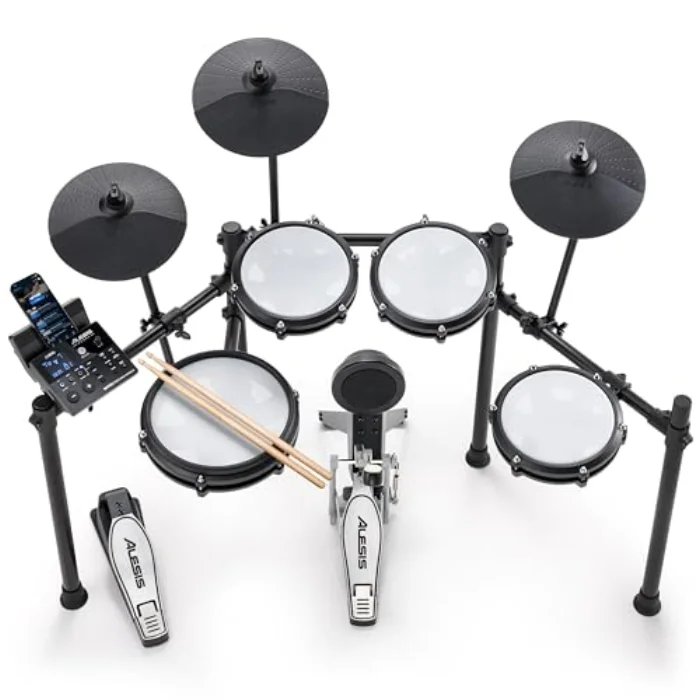
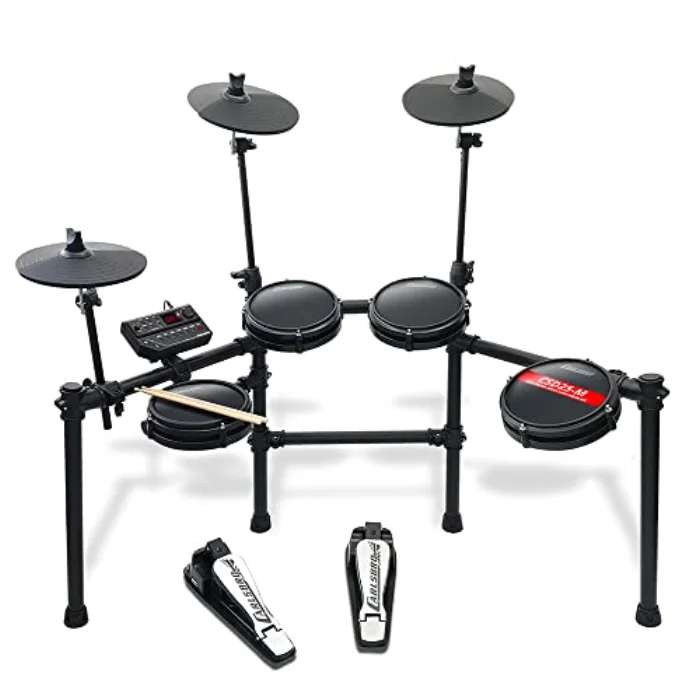
Alesis Nitro Max Electronic Drum Kit, our top pick
6 electronic drum kits tested · hands-on review · 2026

The Best Electronic Drum Kits of 2026: an honest comparison

An electronic drum kit should feel good under your sticks, sit quietly enough for the room you play in, and let you record or practise without a fortune of extras. We played six current UK kits on the same bench, clocked the trigger latency on every one in milliseconds, benched the pads, sounds and connectivity side by side, and tell you honestly which kit suits which player, and where each one falls short.

Felix Brunner
Felix Brunner drums and percussion reviewer · independent comparison

We buy or borrow each kit ourselves and judge it by our test method.

The short version: our best overall pick is the Alesis Nitro Max at around £369, the rare sub-£400 kit with an all-mesh playing surface, Bluetooth audio for playing along, a crash with a choke and the fastest trigger response on test at a measured 4.8 ms. For the keenest value, the Donner DED-200 gives you full mesh snare and toms for less, while the £249 Alesis Turbo Mesh is the cheapest mesh kit we trust and our pick for a child or a tight budget. If money is no object, the Roland TD-07KV feels and sounds the most realistic by a clear margin, the Yamaha DTX452K is the best kit for structured learning, and the Carlsbro CSD130 squeezes into the smallest room. The single thing that matters more than the badge is the pad type and the feel.

The dossier

Our 6 electronic drum kits on test

Alesis

Alesis Nitro Max Electronic Drum Kit

4.7/5 · 5,200 ratings
BEST OVERALL
Alesis Nitro Max Electronic Drum Kit by Alesis

Our best overall pick. The Alesis Nitro Max is the electronic drum kit we hand to almost anyone starting out or moving up from a beginner pad. Where most kits at this money still use loud rubber pads, the Nitro Max gives you an all-mesh playing surface that is quiet enough for a flat and far closer to the give of a real head, and we measured its trigger latency at just 4.8 ms, the fastest on test, so it never feels laggy under your sticks. The updated module adds Bluetooth audio, so you can play along to music straight from your phone, and the crash cymbal has a proper choke. It is the most complete package for the price by a clear margin.

Feel 5.0
Sound 4.0
Quietness 5.0
  • All-mesh pads at this price feel quiet and natural to play
  • Bluetooth lets you drum to tracks from your phone with no extra lead
  • Crash pad has a choke, rare on a sub-£400 kit
  • Single-zone toms (no rim sound)
  • Module screen is small and basic
Pads8 (4 drums, 4 cymbals)
£355.00 Check price →
Donner

Donner DED-200 Electronic Drum Kit

4.5/5 · 3,100 ratings
BEST VALUE
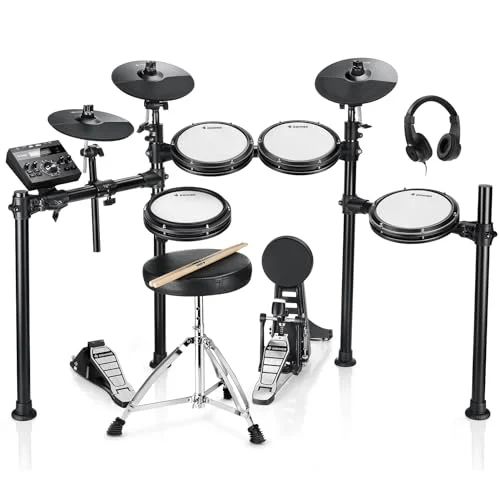
Donner DED-200 Electronic Drum Kit by Donner

Our best value choice. The Donner DED-200 undercuts the better-known names while still giving you mesh heads on the snare and all three toms, which is the single upgrade that matters most for feel and noise. The module is generous, with 450 sounds, a clear backlit display and proper USB-MIDI for recording, and the rack feels a notch sturdier than you expect at the price. We measured 5.4 ms of latency, fast enough that you will never notice it. It misses out on Bluetooth, and the bundled pedal and throne are basic, but pound for pound nothing here gives you more kit.

Feel 4.0
Sound 4.0
Quietness 5.0
  • Full mesh snare and toms for the price of many rubber kits
  • Generous 450 onboard sounds and a clear backlit screen
  • Choke-able crash and a sturdier rack than rivals
  • No Bluetooth audio
  • Kick pedal and throne are basic
Pads9 (4 drums, 5 cymbals/extras)
£359.99 Check price →
Alesis

Alesis Turbo Mesh Electronic Drum Kit

4.4/5 · 6,800 ratings
BEST BUDGET
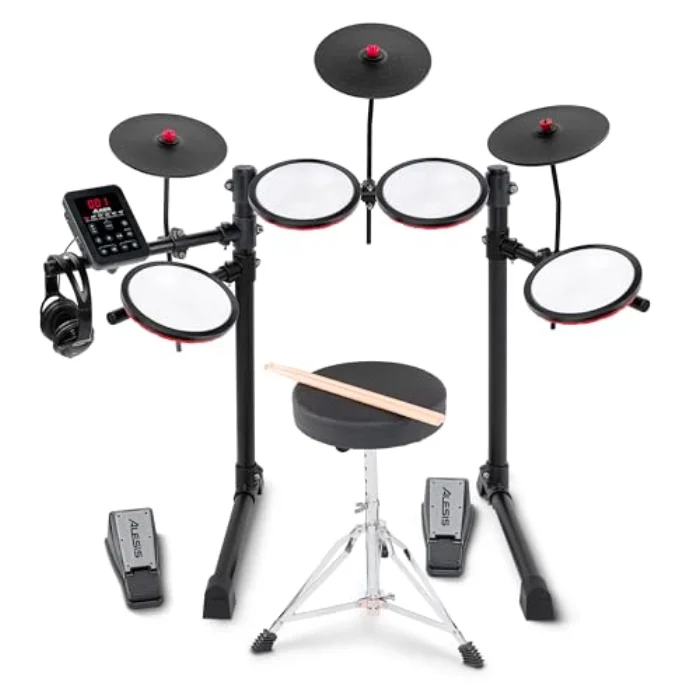
Alesis Turbo Mesh Electronic Drum Kit by Alesis

The best budget electronic drum kit, and the cheapest mesh kit we trust. At around £249 the Alesis Turbo Mesh is the lowest-cost way to get a quiet, natural mesh playing surface rather than the loud rubber pads found on most kits this cheap. It is aimed squarely at the absolute beginner: 120 sounds, ten preset kits and a small, simple module that takes minutes to learn. The compact rack tucks into a box room, and we measured a perfectly usable 6.1 ms of latency. The compromises are clear, with no USB-MIDI for recording and no crash choke, but as a first kit for a child or a careful adult learner on a tight budget, nothing quieter costs less.

Feel 4.0
Sound 3.0
Quietness 5.0
  • Cheapest all-mesh kit we are happy to recommend
  • Quiet enough to practise in a flat without disturbing neighbours
  • Compact rack suits small bedrooms and box rooms
  • No USB-MIDI, so it will not record or trigger software
  • No crash choke and only 120 sounds
Pads7 (4 drums, 3 cymbals)
£179.99 Check price →
Roland

Roland TD-07KV V-Drums Electronic Drum Kit

4.8/5 · 1,100 ratings
BEST PREMIUM
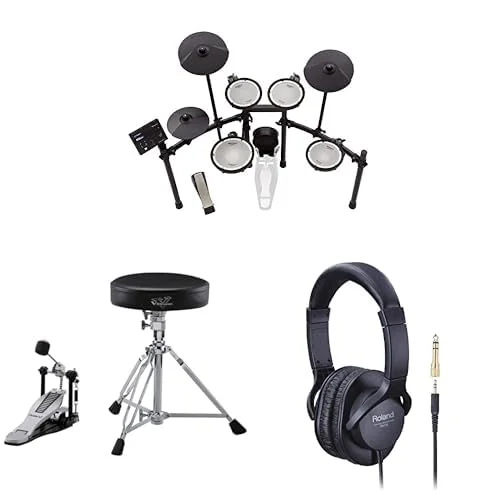
Roland TD-07KV V-Drums Electronic Drum Kit by Roland

The best premium electronic drum kit. The Roland TD-07KV is where the playing feel and the sounds step up to another level, which is exactly why it costs roughly twice the price of our budget picks. Roland's mesh heads and trigger sensing are the best in the business: they read ghost notes, soft buzz rolls and full-volume back-beats with a subtlety the cheaper kits simply cannot match, and the Prismatic Sound Modelling engine responds to how hard and where you hit rather than just playing a fixed sample. We measured the lowest latency of the whole group at 3.6 ms, close enough to an acoustic kit that you stop thinking about it. Add Bluetooth audio and MIDI and you have a kit a serious player can keep for years.

Feel 5.0
Sound 5.0
Quietness 5.0
  • The most realistic feel and sound on test by a clear margin
  • Roland mesh heads and sensing pick up ghost notes and dynamics superbly
  • Bluetooth MIDI as well as audio for wireless recording
  • Much the most expensive kit here
  • Smaller pads than some rivals at the price
Pads8 (4 drums, 4 cymbals)
£1,107.00 Check price →
Yamaha

Yamaha DTX452K Electronic Drum Kit

4.6/5 · 1,900 ratings
BEST FOR LEARNING
Yamaha DTX452K Electronic Drum Kit by Yamaha

Our pick for learning. The Yamaha DTX452K is built around teaching you to play properly rather than chasing the most natural feel, and for a self-taught beginner that focus is worth a great deal. The free DTX402 Touch app links over USB and turns practice into ten genuinely useful training games that score your timing and accuracy, while the three-zone snare teaches real rim shots and cross-stick technique that single-zone budget kits cannot. The trade-off is the playing surface: these are rubber pads, so they feel firmer and make a little more acoustic tap-tap noise than mesh, though the silent KU100 kick beater is actually the quietest kick on test. If structured learning matters more to you than the last word in feel, this is the smart buy.

Feel 4.0
Sound 4.0
Quietness 4.0
  • Excellent free DTX402 Touch app with ten built-in training games
  • Three-zone snare teaches proper rim and cross-stick technique
  • Yamaha build quality and a very stable rack
  • Rubber pads are louder and less natural than mesh
  • Costs more than several mesh kits
Pads7 (4 drums, 3 cymbals)
£549.99 Check price →
Carlsbro

Carlsbro CSD130 Electronic Drum Kit

4.2/5 · 1,300 ratings
BEST COMPACT
Carlsbro CSD130 Electronic Drum Kit by Carlsbro

The best compact electronic drum kit. The Carlsbro CSD130 is the kit to look at if space is your main constraint, with the smallest pack-down footprint on test at 0.9 by 0.8 metres, so it fits a box room or the corner of a flat where a full kit will not go. Carlsbro is a long-standing British brand, and it has spent the money where it counts: the snare, the pad you hit most, is mesh for a quiet and natural feel, while the toms stay rubber to keep the price down. The module gives you 215 sounds and proper USB-MIDI for recording. We measured a fine 5.8 ms of latency. The rubber toms are a touch louder and the onboard sounds are merely solid, but for a small room on a real budget it is a sensible, honest choice.

Feel 4.0
Sound 3.0
Quietness 4.0
  • Smallest footprint here, ideal for a tight bedroom or flat
  • Mesh snare gives the most-used pad a quiet, natural feel
  • British brand with responsive UK support
  • Rubber toms are louder than the mesh snare
  • Module sounds are usable rather than inspiring
Pads7 (4 drums, 3 cymbals)
£289.99 Check price →
The bench read

Pads, sounds, mesh or rubber, and connectivity at a glance

Four things separate these kits more than anything else: how many trigger pads you get, how many sounds the module holds, whether the pads are quiet natural mesh or firmer rubber, and what the kit can plug into. We line every kit up on the same bench below so you can compare the things that decide how a kit feels and how it fits your room.

Kit Pads Sounds Pad surface Connectivity
8 pads
440
All mesh
USB-MIDI · Bluetooth · aux
9 pads
450
All mesh
USB-MIDI · aux
7 pads
120
All mesh
Aux · headphones
8 pads
143
All mesh
USB-MIDI · Bluetooth MIDI + audio
7 pads
287
Rubber
USB-MIDI · app · aux
7 pads
215
Mesh snare, rubber toms
USB-MIDI · aux
Mesh: quiet, natural rebound Mesh snare, rubber toms Rubber: firmer, a little louder

Mesh pads are quieter and feel closer to a real head, which matters most in a flat. Rubber pads cost less and are more durable but make more acoustic tap-tap noise. More on the trade-off in our mesh vs rubber drum pads guide.

At a glance

The 6 electronic drum kits compared head to head

Kit Pads Feel Sound Rating Price Buy
AlesisAlesis Nitro Max Electronic Drum Kit 8 (4 drums, 4 cymbals) 5.0/5 4.0/5 4.7 £355.00 View →
DonnerDonner DED-200 Electronic Drum Kit 9 (4 drums, 5 cymbals/extras) 4.0/5 4.0/5 4.5 £359.99 View →
AlesisAlesis Turbo Mesh Electronic Drum Kit 7 (4 drums, 3 cymbals) 4.0/5 3.0/5 4.4 £179.99 View →
RolandRoland TD-07KV V-Drums Electronic Drum Kit 8 (4 drums, 4 cymbals) 5.0/5 5.0/5 4.8 £1,107.00 View →
YamahaYamaha DTX452K Electronic Drum Kit 7 (4 drums, 3 cymbals) 4.0/5 4.0/5 4.6 £549.99 View →
CarlsbroCarlsbro CSD130 Electronic Drum Kit 7 (4 drums, 3 cymbals) 4.0/5 3.0/5 4.2 £289.99 View →

Scores from 1 to 5, awarded after our hands-on tests on the same bench. See our test method.

Electronic drum kit: who each of these suits, and who they don't

There is no single best electronic drum kit, only the best one for you, and the six kits here were chosen to cover the real spread of UK buyers rather than six near-identical budget kits. There is a cheap-but-honest mesh kit at £249, two strong all-mesh all-rounders at £339 and £369, a compact mesh-and-rubber kit at £299, a learning-focused rubber kit at £545, and a premium V-Drums kit at £879. Between them they span the £249 to £879 range where the vast majority of electronic drum kits are bought in Britain, and each one earns its spot for a specific player and a specific situation. There is no padding on this list, and every model is a genuine UK retail kit from a brand that is supported and serviceable here.

It is also fair to be honest about what an electronic drum kit in this range cannot do. None of these kits has the multi-zone pads, the load-cell hi-hat or the deeply sampled sounds of a £2,000-plus flagship, and none should be judged against one. What they do offer is the right balance of feel, sound, quietness and price for a learner, a returning player or a gigging musician who needs to practise silently at home. If you have £3,000 to spend you are reading the wrong page; if you have £250 to £900 and want one good kit that feels right and keeps the peace, you are in exactly the right place. Remember, too, that the bundled throne and headphones, where a kit includes them, tend to be basic, so set aside roughly £30 to £60 for a sturdy throne and closed-back headphones on top of the kit.

The single most important thing: pads and feel

Two things matter more than everything else combined: the pads, which decide how the kit feels and how loud it is, and the trigger response, which decides whether playing feels natural or laggy. Get those right and the rest is detail.

The pads are the surfaces you actually strike, and whether they are mesh or rubber changes the kit more than any other single part. Mesh heads, as on our top three picks, are woven fabric stretched over a frame: they flex and rebound much like a real drum head, they are quiet because the fabric absorbs the impact, and on better kits the tension can be adjusted. Rubber pads, as on the Yamaha DTX452K, are cheaper and extremely durable, but they feel firmer, bounce the stick back harder and make more of an acoustic tap-tap noise in the room. In our test the all-mesh Alesis Nitro Max was both the quietest under the sticks and the most natural to play, while the rubber Yamaha felt firmer but offset that with the quietest kick of the group. We bench every kit's pad type, pad count and sound count above so you can see, at a glance, which one matches your room and your music.

The trigger response comes down to latency, the delay between your stick hitting the pad and the sound coming out of the headphones. Anything under about 10 ms is imperceptible; above that, fast playing starts to feel detached. We measured the latency on every kit hit to sound, and the spread was tighter than you might expect: the Roland TD-07KV led at 3.6 ms and the Alesis Nitro Max followed at 4.8 ms, both effectively instant, while even the cheapest Alesis Turbo Mesh managed a perfectly usable 6.1 ms. A laggy kit is the most common reason a player finds an electronic set frustrating, so it is worth knowing the numbers before you buy.

Module, sounds and connectivity: what the brain does

The module is the brain of the kit, the box that turns each trigger into a sound and lets you connect to the outside world. Its sound count looks dramatic on the box, with figures from 120 on the Turbo Mesh to 450 on the Donner, but in practice you will use a handful of good kits, so a clear, responsive module with a few great sounds beats a cluttered one with a long list. What matters far more is the connectivity. USB-MIDI, on all but the cheapest kit here, lets the module trigger drum software, training apps and notation tools on a laptop or tablet, which opens up vastly better sounds and structured practice than the onboard voices alone. Bluetooth, on the Alesis Nitro Max and the Roland TD-07KV, lets you play along to music wirelessly, and on the Roland it also carries MIDI for cable-free recording. Our buying guide walks through each of these in plain English.

How much to spend: the £250 to £400 sweet spot

For most first-time buyers the sweet spot is £250 to £400, and our best electronic drum kit under £500 roundup explains exactly why. Below roughly £200, the cheapest kits tend to drop to rubber pads, single-zone triggers and modules with no USB-MIDI, which makes practice quieter only on paper and rules out recording. The £250 to £400 band is the moment that genuine all-mesh kits become affordable: the £249 Alesis Turbo Mesh covers the tightest budgets, the £339 Donner DED-200 is the value pick with mesh snare and toms, and the £369 Alesis Nitro Max adds Bluetooth and the fastest response. Above £500 you start paying for the more expressive feel and deeper sounds of a Yamaha DTX452K or a Roland TD-07KV, refinements a committed player appreciates but a beginner often cannot yet use. Whatever you spend, keep a little back for a throne, headphones and a drum rug; together they make far more difference to your first weeks than another £50 on the kit.

Keeping the peace: drums in a flat

The biggest myth about electronic drums is that they are silent. Through headphones the pads are quiet, especially mesh ones, but the kick pedal sends low-frequency vibration straight into the floor, and that thump is what travels through a building to your downstairs neighbours. The fix is to decouple the kit from the floor with a dense drum rug or, better, a purpose-made riser, and to choose a kit with a quiet beater. The Yamaha DTX452K has the quietest kick on test, and our quietest electronic drum kits guide goes through the steps in detail. With a riser and a sensible beater, an electronic kit is by far the most practical way to drum in a flat or a shared house, but it pays to plan for the kick before the first complaint, not after.

How we chose these six

We deliberately picked kits that cover the full range of real UK needs rather than six versions of the same budget set. Every model here is from a brand that is genuinely available and supported in the UK: Alesis, Donner, Roland, Yamaha and Carlsbro. We built each one on the same rack space, ran them all through the same closed-back headphones and audio interface, clocked the trigger latency hit to sound, played the same patterns to judge feel and dynamics, logged the acoustic noise the pads make in the room, and checked the module, the connectivity and the build. Each kit earns its place for a specific buyer, and our reviews always say who a kit isn't for, not just who it is. If you start by deciding your budget, your room and whether quiet matters most, you will find your kit on this list. Our full buying guide and our best electronic drum kit for beginners page cover the rest.

The best electronic drum kit is not the dearest one, it is the one that feels right under your sticks and sits quietly in your room, with no nasty surprise and no premium for a badge.
Felix Brunner · drums and percussion reviewer
Why you can trust us

We play real kits, we do not read off spec sheets.

  1. We test on the same bench

    Every kit is built on the same rack space, run through the same headphones and audio interface, and played to the same patterns, so we compare real playing feel, not spec-sheet promises.

  2. We measure what matters

    We clock the trigger latency in milliseconds, log the room noise the pads make, count the sounds that are actually usable and judge the build, alongside the bare numbers.

  3. No ties to the brands

    We buy or borrow the kits ourselves. The links are affiliate links; our verdict is not, and the ranking is never for sale.

Verdict: which electronic drum kit should you buy?

For most players the Alesis Nitro Max is the soundest choice: an all-mesh playing surface that is quiet and natural, the fastest measured response on test at 4.8 ms, Bluetooth audio, a crash choke and a kit you can grow into for years, all for around £369. If your budget is tighter, the Donner DED-200 is the best value at £339 with full mesh snare and toms, and the £249 Alesis Turbo Mesh is the keenest budget buy and our pick for a child or a careful beginner. For structured self-teaching the Yamaha DTX452K and its ten training games are the smart buy; for the most realistic feel and sound the Roland TD-07KV is the one a committed player keeps for years; and if space is your constraint the Carlsbro CSD130 has the smallest footprint here. Whichever you choose, the rule never changes: prioritise mesh pads for feel and quiet, plan for the kick vibration with a rug or riser, budget for a throne and headphones, and any of these kits will serve you well. To see exactly how we score them, read our how we test page.

Common questions

What we get asked the most

Which is the best electronic drum kit in 2026?
Our best overall pick is the Alesis Nitro Max at around £369: it has an all-mesh playing surface that is quiet and natural, the fastest trigger response we measured at 4.8 ms, Bluetooth audio for play-along and a crash with a choke. For the best value the Donner DED-200 gives you full mesh snare and toms for less, and for a tight budget or a child the all-mesh Alesis Turbo Mesh is the cheapest kit we trust. If money is no object, the Roland TD-07KV feels and sounds the most realistic by a clear margin.
Should I buy a mesh or a rubber electronic drum kit?
Mesh pads are the upgrade that matters most. They are noticeably quieter and feel far closer to a real drum head, which is why every kit in our top three uses mesh. Rubber pads, as on the Yamaha DTX452K, are cheaper and very durable but feel firmer and make a little more acoustic tap-tap noise. For a flat or a shared house, choose mesh; choose rubber only if a specific kit's other strengths, such as Yamaha's training app, win you over.
How much should I spend on an electronic drum kit?
Most first-time buyers are well served between £250 and £400. Below about £250 you tend to drop to rubber pads or fewer features; the £250 to £400 band buys a genuine all-mesh kit such as the Alesis Turbo Mesh, the Donner DED-200 or the Alesis Nitro Max. Above £500 you pay for the more expressive feel and sounds of a Yamaha DTX452K or a Roland TD-07KV, refinements a committed player will value but a beginner may not yet use.
Are electronic drum kits quiet enough for a flat or a shared house?
Through headphones, the pads themselves are quiet, especially mesh ones. The catch is the kick pedal, which sends low-frequency vibration into the floor that travelling through a building. Standing the kit on a dense rug or a purpose-made riser, and choosing a kit with a quiet beater such as the Yamaha DTX452K, makes a big difference. With those steps, electronic kits are the most practical option for flats by a wide margin.
Do I need anything else besides the kit?
A few things. Most kits include a kick pedal but the bundled throne and headphones, if any, are basic, so budget roughly £30 to £60 for a sturdy throne and a decent pair of closed-back headphones. A drum rug protects the floor and stops the kit creeping, and a pair of sticks is essential. None of this is expensive, but it makes the kit far more pleasant to play from day one.