Electronic Drum Kit Buying Guide: what really matters

Buying an electronic drum kit is more confusing than it should be, with long sound lists, vague feel claims and a real gulf between kits that look similar on paper. This guide cuts through it. We explain what actually decides how a kit feels, how quiet it is and whether it can grow with you, in plain English and in the order that matters.

Transparency: This article contains affiliate links. If you buy through one of them, we may earn a commission, at no extra cost to you. That is how we fund our testing and keep this site independent. More about how we test.

Contents

Our selection

Model Price PadsSnare / tomsCymbals Rating Link
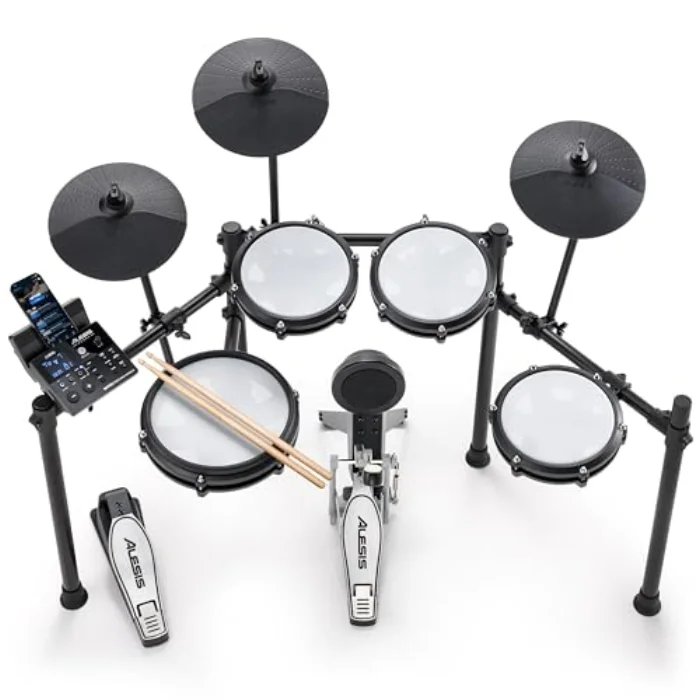
Alesis Nitro Max Electronic Drum Kit ★ Top pick Alesis Nitro Max Electronic Drum Kit £355.00 8 (4 drums, 4 cymbals)All-mesh, dual-zone snare3 (hi-hat, crash with choke, ride) ★ 4.7 View →
Donner DED-200 Electronic Drum Kit Donner DED-200 Electronic Drum Kit £359.99 9 (4 drums, 5 cymbals/extras)Mesh snare and toms3 (hi-hat, crash with choke, ride) ★ 4.5 View →
Alesis Turbo Mesh Electronic Drum Kit Alesis Turbo Mesh Electronic Drum Kit £179.99 7 (4 drums, 3 cymbals)All-mesh, single-zone3 (hi-hat, crash, ride) ★ 4.4 View →
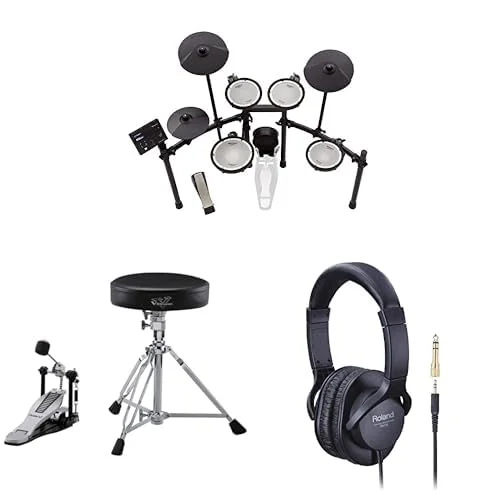
Roland TD-07KV V-Drums Electronic Drum Kit Roland TD-07KV V-Drums Electronic Drum Kit £1,107.00 8 (4 drums, 4 cymbals)Dual-zone mesh snare, mesh toms3 (hi-hat, crash with choke, ride with bell) ★ 4.8 View →
Yamaha DTX452K Electronic Drum Kit Yamaha DTX452K Electronic Drum Kit £549.99 7 (4 drums, 3 cymbals)Rubber, 3-zone snare (head, rim, cross-stick)3 (hi-hat, crash with choke, ride) ★ 4.6 View →
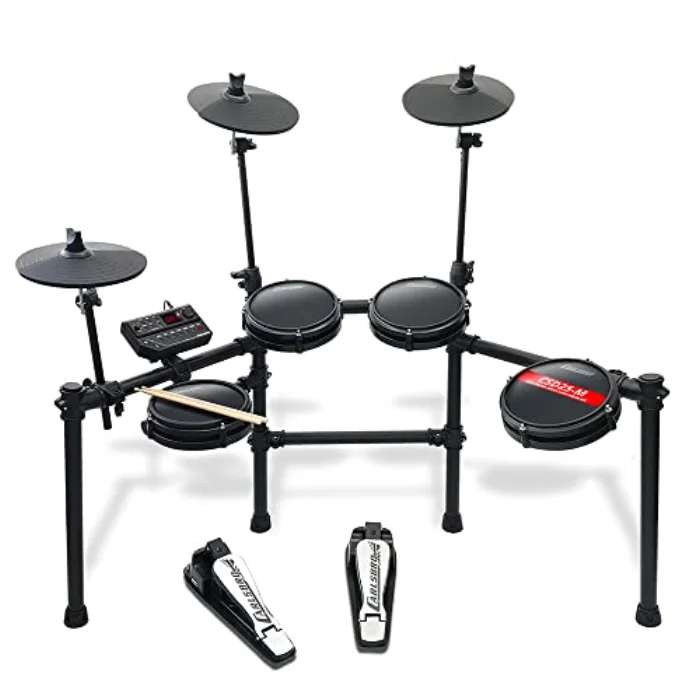
Carlsbro CSD130 Electronic Drum Kit Carlsbro CSD130 Electronic Drum Kit £289.99 7 (4 drums, 3 cymbals)Mesh snare, rubber toms3 (hi-hat, crash, ride) ★ 4.2 View →
★ Top pick
Alesis Nitro Max Electronic Drum Kit £355.00
Pads : 8 (4 drums, 4 cymbals)Snare / toms : All-mesh, dual-zone snareCymbals : 3 (hi-hat, crash with choke, ride) ★ 4.7/5
View on Amazon →
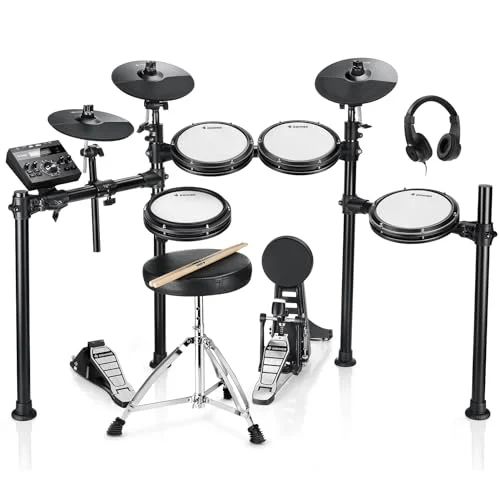
Donner DED-200 Electronic Drum Kit £359.99
Pads : 9 (4 drums, 5 cymbals/extras)Snare / toms : Mesh snare and tomsCymbals : 3 (hi-hat, crash with choke, ride) ★ 4.5/5
View on Amazon →
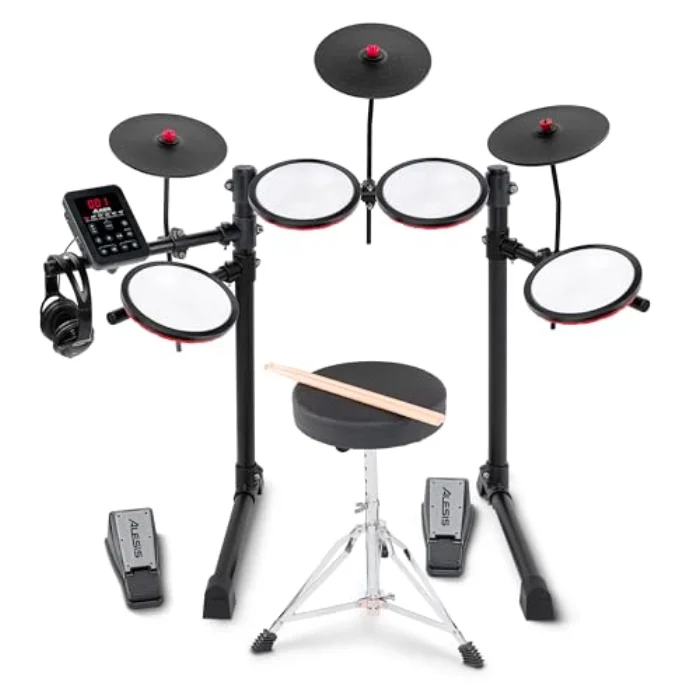
Alesis Turbo Mesh Electronic Drum Kit £179.99
Pads : 7 (4 drums, 3 cymbals)Snare / toms : All-mesh, single-zoneCymbals : 3 (hi-hat, crash, ride) ★ 4.4/5
View on Amazon →
Roland TD-07KV V-Drums Electronic Drum Kit £1,107.00
Pads : 8 (4 drums, 4 cymbals)Snare / toms : Dual-zone mesh snare, mesh tomsCymbals : 3 (hi-hat, crash with choke, ride with bell) ★ 4.8/5
View on Amazon →
Yamaha DTX452K Electronic Drum Kit £549.99
Pads : 7 (4 drums, 3 cymbals)Snare / toms : Rubber, 3-zone snare (head, rim, cross-stick)Cymbals : 3 (hi-hat, crash with choke, ride) ★ 4.6/5
View on Amazon →
Carlsbro CSD130 Electronic Drum Kit £289.99
Pads : 7 (4 drums, 3 cymbals)Snare / toms : Mesh snare, rubber tomsCymbals : 3 (hi-hat, crash, ride) ★ 4.2/5
View on Amazon →
BEST OVERALL
Alesis Nitro Max Electronic Drum Kit - electronic drum kit Alesis

Alesis Nitro Max Electronic Drum Kit

4.7/5

£355.00

8 (4 drums, 4 cymbals) · All-mesh, dual-zone snare · 3 (hi-hat, crash with choke, ride)

  • All-mesh pads at this price feel quiet and natural to play
  • Bluetooth lets you drum to tracks from your phone with no extra lead
  • Crash pad has a choke, rare on a sub-£400 kit
  • Lowest measured trigger latency on test at 4.8 ms
  • Single-zone toms (no rim sound)
  • Module screen is small and basic
Feel 5/5
Sound 4/5
Quietness 5/5
View on Amazon →
BEST VALUE
Donner DED-200 Electronic Drum Kit - electronic drum kit Donner

Donner DED-200 Electronic Drum Kit

4.5/5

£359.99

9 (4 drums, 5 cymbals/extras) · Mesh snare and toms · 3 (hi-hat, crash with choke, ride)

  • Full mesh snare and toms for the price of many rubber kits
  • Generous 450 onboard sounds and a clear backlit screen
  • Choke-able crash and a sturdier rack than rivals
  • USB-MIDI works straight away with recording software
  • No Bluetooth audio
  • Kick pedal and throne are basic
Feel 4/5
Sound 4/5
Quietness 5/5
View on Amazon →
BEST BUDGET
Alesis Turbo Mesh Electronic Drum Kit - electronic drum kit Alesis

Alesis Turbo Mesh Electronic Drum Kit

4.4/5

£179.99

7 (4 drums, 3 cymbals) · All-mesh, single-zone · 3 (hi-hat, crash, ride)

  • Cheapest all-mesh kit we are happy to recommend
  • Quiet enough to practise in a flat without disturbing neighbours
  • Compact rack suits small bedrooms and box rooms
  • Simple module is easy for a complete beginner
  • No USB-MIDI, so it will not record or trigger software
  • No crash choke and only 120 sounds
Feel 4/5
Sound 3/5
Quietness 5/5
View on Amazon →
BEST PREMIUM
Roland TD-07KV V-Drums Electronic Drum Kit - electronic drum kit Roland

Roland TD-07KV V-Drums Electronic Drum Kit

4.8/5

£1,107.00

8 (4 drums, 4 cymbals) · Dual-zone mesh snare, mesh toms · 3 (hi-hat, crash with choke, ride with bell)

  • The most realistic feel and sound on test by a clear margin
  • Roland mesh heads and sensing pick up ghost notes and dynamics superbly
  • Bluetooth MIDI as well as audio for wireless recording
  • Fastest measured latency at 3.6 ms, indistinguishable from acoustic
  • Much the most expensive kit here
  • Smaller pads than some rivals at the price
Feel 5/5
Sound 5/5
Quietness 5/5
View on Amazon →
BEST FOR LEARNING
Yamaha DTX452K Electronic Drum Kit - electronic drum kit Yamaha

Yamaha DTX452K Electronic Drum Kit

4.6/5

£549.99

7 (4 drums, 3 cymbals) · Rubber, 3-zone snare (head, rim, cross-stick) · 3 (hi-hat, crash with choke, ride)

  • Excellent free DTX402 Touch app with ten built-in training games
  • Three-zone snare teaches proper rim and cross-stick technique
  • Yamaha build quality and a very stable rack
  • Silent kick beater is the quietest of any kit on test
  • Rubber pads are louder and less natural than mesh
  • Costs more than several mesh kits
Feel 4/5
Sound 4/5
Quietness 4/5
View on Amazon →
BEST COMPACT
Carlsbro CSD130 Electronic Drum Kit - electronic drum kit Carlsbro

Carlsbro CSD130 Electronic Drum Kit

4.2/5

£289.99

7 (4 drums, 3 cymbals) · Mesh snare, rubber toms · 3 (hi-hat, crash, ride)

  • Smallest footprint here, ideal for a tight bedroom or flat
  • Mesh snare gives the most-used pad a quiet, natural feel
  • British brand with responsive UK support
  • USB-MIDI included for recording at the price
  • Rubber toms are louder than the mesh snare
  • Module sounds are usable rather than inspiring
Feel 4/5
Sound 3/5
Quietness 4/5
View on Amazon →

Mesh vs rubber pads: the choice that matters most

If you read nothing else, read this. The single biggest factor in how an electronic drum kit feels and how much noise it makes is whether the pads are mesh or rubber, and it matters more than the brand, the price or the number of sounds. Mesh heads are woven fabric stretched over a frame, like a tiny trampoline. They flex under the stick and rebound much like a real drum head, they are quiet because the fabric absorbs the impact, and on better kits the tension can be adjusted to taste. Rubber pads are solid, cheaper and almost indestructible, but they feel firmer, bounce the stick back harder and make noticeably more acoustic tap-tap noise in the room.

For most buyers, especially anyone in a flat or a shared house, mesh is the upgrade worth paying for, which is why all three of our top picks use it. The good news in 2026 is that mesh, once a premium feature, is now affordable: the £249 Alesis Turbo Mesh proves you no longer have to spend a fortune for it. Rubber is not a write-off, though. A kit like the Yamaha DTX452K pairs rubber pads with a strong training app and a near-silent kick, so its other strengths can win you over. Our dedicated mesh vs rubber drum pads guide goes deeper, but the rule of thumb is simple: choose mesh unless a rubber kit offers something specific you want more.

Pads, zones and the kick

A standard electronic kit gives you four drum pads, a snare and three toms, and three cymbals, a hi-hat, a crash and a ride, plus a kick trigger and pedal. That eight-piece layout is plenty to learn on and matches the muscle memory you would build on an acoustic kit. More pads are nice but rarely essential for a first or second kit. What is worth checking is zones: a multi-zone pad produces different sounds depending on where you hit it, so a dual-zone snare gives a separate rim shot, and a three-zone snare like the Yamaha's adds a cross-stick. Single-zone pads, common on the cheapest kits, play one sound wherever you strike them, which is fine for early learning but limits technique later.

The kick deserves a moment too. Most kits in this range use a small trigger pad struck by a normal beater on a pedal, which works well and feels natural. A few, like the Yamaha DTX452K, use a silent beater pad instead, which is the quietest option and worth seeking out if neighbours are a concern. The hi-hat on budget kits is usually a simple pedal switch rather than a continuously variable controller, so you get open and closed but not the in-between positions; that is normal at this price and not something a beginner will miss for a good while.

Trigger latency: why it matters and what is good

Latency is the delay between your stick hitting the pad and the sound reaching your ears, and it is the difference between a kit that feels alive and one that feels detached. Anything under about 10 ms is imperceptible to a player; above that, fast passages start to feel like they are dragging. The good news is that every kit we tested came in well under that threshold, from 3.6 ms on the Roland TD-07KV to 6.1 ms on the cheapest Alesis Turbo Mesh. Manufacturers rarely publish a latency figure, which is exactly why we measure it ourselves. If you ever play a kit in a shop and it feels sluggish, the cause is almost always poor triggering or a slow module rather than your technique, and it is a genuine reason to walk away.

Module, sounds and connectivity

The module is the brain of the kit. Two things matter about it, and a third does not. The number that does not matter much is the sound count: figures from 120 to 450 look impressive, but you will use a handful of good kits and ignore the rest, so a clear, responsive module with a few great sounds beats a cluttered one with a long list. What does matter is USB-MIDI. This lets the kit trigger drum software, training apps and notation tools on a laptop or tablet, which unlocks vastly better sounds and structured practice than the onboard voices alone. We treat its absence, as on the budget Turbo Mesh, as a real mark against a kit you might keep for years. The MIDI itself follows the standard MIDI specification, so any kit with USB-MIDI works with any modern recording software.

The other thing worth having is Bluetooth. Bluetooth audio, on the Alesis Nitro Max and the Roland TD-07KV, lets you stream backing tracks from your phone and play along with no cable, which is more useful day to day than any number of extra sounds. The Roland goes further with Bluetooth MIDI, so you can record into software wirelessly. None of this is essential, but if two kits are otherwise close, the one with better connectivity is the one you will still be enjoying in three years.

Keeping it quiet in a flat

The biggest myth about electronic drums is that they are silent. Through headphones the pads are quiet, especially mesh ones, but the kick pedal sends low-frequency vibration straight into the floor, and that thump is what carries through a building to your neighbours below. No kit avoids this entirely; the fix is to decouple the kit from the floor. A dense drum rug helps, and a purpose-made riser or a sheet of rubber matting helps more, absorbing the low thud that travels. Choosing a kit with a quiet beater, like the Yamaha's silent KU100, reduces it further still. We cover the full set of steps in our quietest electronic drum kits guide; the key point at buying time is to plan for the kick before the first complaint, not after.

How much to spend

For most first-time buyers the sweet spot is £250 to £400. Below about £200, kits tend to drop to rubber pads, single-zone triggers and modules with no USB-MIDI, so you save money in the places that matter most. The £250 to £400 band is where genuine all-mesh kits become affordable: the £249 Alesis Turbo Mesh for the tightest budget, the £339 Donner DED-200 for full mesh value, and the £369 Alesis Nitro Max for the best all-round package. Above £500 you pay for the more expressive feel and deeper sounds of a Yamaha DTX452K or a Roland TD-07KV, which a committed player will value but a beginner may not yet use. Our best electronic drum kit under £500 roundup focuses on that core band.

The extras you need

The kit is not the whole bill. Most kits include a kick pedal, but the bundled throne and headphones, where they exist, tend to be basic, so budget roughly £30 to £60 for a sturdy, height-adjustable throne and a decent pair of closed-back headphones, which together transform the playing experience. A drum rug protects the floor, stops the kit creeping and helps with noise. A pair of sticks is essential and cheap. None of this is expensive, but skipping it is the most common way a new kit ends up feeling less pleasant than it should, so factor it into your budget from the start.
Frequently asked questions

Q
What should I look at first when buying an electronic drum kit?

The pads. Whether they are mesh or rubber decides both how natural the kit feels and how much noise it makes, and it matters more than the brand or the number of sounds. After that, look at the number of pads and zones, whether the module has USB-MIDI for recording, and the quality of the kick and hi-hat, which are what beginners outgrow first.

Q
How many pads and sounds do I actually need?

For a first kit, four drum pads (snare and three toms) and three cymbals (hi-hat, crash, ride) is the standard layout and plenty to learn on. Hundreds of onboard sounds look impressive on the box, but you will use a handful of good kits in practice. A clear, responsive module with a few great sounds beats a cluttered one with a long list.

Q
Is USB-MIDI worth having on an electronic drum kit?

Yes, if there is any chance you will record or use practice apps. USB-MIDI lets the kit trigger drum software and notation or training apps on a laptop or tablet, which opens up far better sounds and structured practice than the module alone. It costs little to include, so we treat its absence as a real mark against a kit you might keep for years.

The short answer

If you want a single recommendation, the Alesis Nitro Max is the kit we would point most buyers to: an all-mesh feel, Bluetooth, USB-MIDI and the fastest response on test, for around £369. For the best value go for the Donner DED-200, for the tightest budget the Alesis Turbo Mesh, for structured learning the Yamaha DTX452K, and for the most realistic feel the Roland TD-07KV. Whatever you choose, prioritise mesh pads, check the kit can record over USB-MIDI if that matters, plan for the kick vibration, and keep a little back for a throne and headphones. Get those right and you will be playing, not fiddling, from day one. To see how we arrive at our scores, read our how we test page.