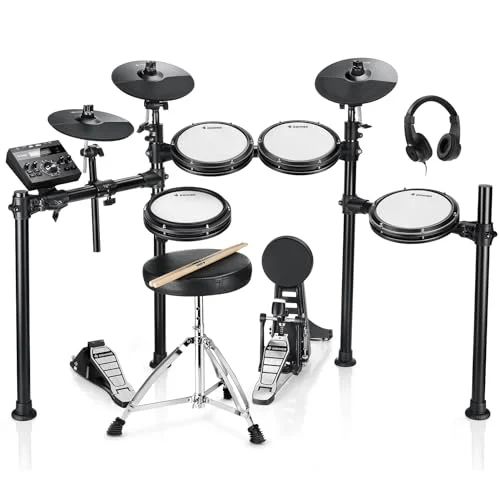
Donner has grown fast in the UK by undercutting the established brands while matching them on the spec that matters, and the DED-200 is the kit that made its name. At around £339 it offers something that used to cost a good deal more: an all-mesh playing surface, a backlit module with 450 sounds, a choke-able crash and USB-MIDI for recording. It is the kit we recommend to anyone who wants the most drum for the least money, and the value pick on our list.
Tested June 2026 · last updated June 2026
What we measured 5.4msTrigger latency
9Pads / triggers
450Onboard sounds
1.0mFootprint width
Donner DED-200: full specifications | Pads | 9 triggers: snare, 3 toms, hi-hat, crash, ride, kick, plus extras |
|---|
| Snare and toms | Mesh snare and mesh toms |
|---|
| Cymbals | Hi-hat, crash with choke, ride |
|---|
| Module | DED-200, 450 sounds, 30 preset kits, backlit screen |
|---|
| Connectivity | USB-MIDI, aux in, headphone out |
|---|
| Kick | Trigger pad with included single pedal |
|---|
| Trigger latency (measured) | 5.4 ms hit to sound |
|---|
| Pack-down footprint | 1.0 x 0.9 m |
|---|
| Typical UK price | £339 |
|---|
Who is the Donner DED-200 for?
The DED-200 is the right kit if your budget is firm but you refuse to drop to rubber pads, which describes a great many first-time buyers. The single most expensive ingredient in any electronic kit is mesh heads, and Donner has spent its money there, putting mesh on the snare and all three toms rather than just the snare. That makes it the cheapest way here to get a fully mesh playing surface, with the quiet, natural feel that follows. It suits a beginner who wants the best feel per pound, a returning player setting up a home practice corner, or a parent buying a kit that the child will not outgrow in a few months.
It is less suited to two groups. Players who want wireless play-along will miss the Bluetooth found on the similarly priced Alesis Nitro Max, and anyone chasing the most expressive professional feel should look at the Roland TD-07KV. For the value-focused buyer who just wants the most mesh and the most sounds for the money, though, the Donner is hard to beat.
How the Donner DED-200 performs
Feel and response
The full mesh layout is the reason to buy this kit, and it delivers. The snare and all three toms have a soft, even rebound that is close to a real head and a world away from the firm slap of rubber, and the kit stays genuinely quiet in the room as a result. We measured a trigger latency of 5.4 ms hit to sound, comfortably below the roughly 10 ms threshold at which lag becomes noticeable, so the kit feels immediate under the sticks. Over a week of daily playing the triggers held up well, tracking soft and hard hits cleanly, though the sensitivity on the cymbals took a little tuning in the module menu to get exactly right.
Sounds, module and connectivity
The DED-200 module is generous for the price, with 450 sounds across 30 preset kits and a clear backlit screen that is easier to read than some rivals. As always, the long sound list flatters to deceive a little: you will use a handful of strong kits and ignore most of the rest, but the good ones are good. The key feature is USB-MIDI, which conforms to the standard USB MIDI device class so it works straight away with a laptop or tablet, letting the kit trigger recording software and drum apps with no driver faff. There is no Bluetooth, so play-along has to come through the aux input on a cable, which is the main thing you give up against the Alesis. The onboard recorder and metronome both work as described in Donner's published specification and are handy for practice.
Build, noise and setup
The rack felt a notch sturdier than we expected at the price, with thick tubing and clamps that held firm over a fortnight of playing. Setup took us around an hour, and while the printed manual is brief, the layout is intuitive enough that an adult will not struggle. The mesh pads keep the acoustic noise low, so this is a kit you can practise on late through headphones; as with every electronic kit, the kick pedal is the part that sends vibration into the floor, so a rug or riser is worth fitting in a flat. The supplied kick pedal and the absence of a throne are the usual budget-kit caveats.
The honest downsides
There are two main ones. First, there is no Bluetooth, so unlike the Alesis Nitro Max at a similar price you cannot stream backing tracks wirelessly; you will need a cable into the aux input instead. Second, the bundled kick pedal and throne, where included, are basic, and the cymbal sensitivity benefits from a few minutes in the menu before it feels right. None of these is a deal-breaker, and against a full mesh playing surface and a generous module at this price, they are easy compromises to accept. The sounds, while plentiful, are solid rather than inspiring at the very top end.
The good
- Full mesh snare and toms, rare at this price
- Generous 450 sounds and a clear backlit screen
- Choke-able crash and a sturdy rack
- USB-MIDI works straight away for recording
- Fast 5.4 ms measured trigger response
The not-so-good
- No Bluetooth audio for wireless play-along
- Cymbal sensitivity needs tuning out of the box
- Bundled pedal and throne are basic
- Top-end sounds are solid rather than special
Best for: the value-focused buyer who wants the most mesh and the most sounds for the money and does not mind playing along on a cable. Not the pick if Bluetooth play-along matters (try the Alesis Nitro Max) or you want the most expressive feel (try the Roland TD-07KV).