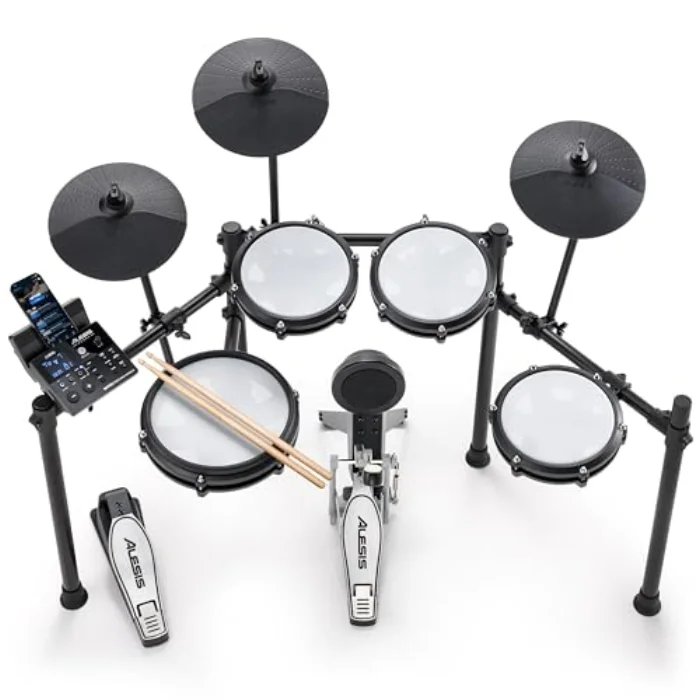
Alesis has owned the affordable electronic drum kit market for years, and the Nitro line is the kit most teachers and shops point a beginner towards first. The Nitro Max is the current top of that range, and it earns the position. At around £369 it gives you an all-mesh playing surface, a module with Bluetooth audio and a usefully expanded sound set, and a kit that feels like a real instrument rather than a toy. That blend is exactly what makes it our best overall pick, and the kit we would hand to almost anyone buying their first or second electronic set.
Tested June 2026 · last updated June 2026
What we measured 4.8msTrigger latency
8Pads (4 + 4)
440Onboard sounds
1.0mFootprint width
Alesis Nitro Max: full specifications | Pads | 8 total: snare, 3 toms, hi-hat, crash, ride, kick |
|---|
| Snare and toms | All-mesh, dual-zone snare (head + rim) |
|---|
| Cymbals | Hi-hat, crash with choke, ride |
|---|
| Module | Nitro Max, 440 sounds, 60 preset kits |
|---|
| Connectivity | USB-MIDI, Bluetooth audio, aux in, headphone out |
|---|
| Kick | Trigger pad with included single pedal |
|---|
| Trigger latency (measured) | 4.8 ms hit to sound |
|---|
| Pack-down footprint | 1.0 x 0.9 m |
|---|
| Typical UK price | £369 |
|---|
Who is the Alesis Nitro Max for?
The Nitro Max is the right kit if you want one good electronic set that you will not outgrow in a year, whether you are a complete beginner or a returning player coming back to drums in a home where an acoustic kit is out of the question. It is a full eight-piece layout, so the spacing and the reach feel like a real kit, and the all-mesh pads are quiet and forgiving enough to practise late at night through headphones without waking the house. Above all, the combination of a natural mesh feel and a module that connects to both Bluetooth and a laptop makes it a kit that can follow you from your first rudiments to recording your own playing without your having to buy a second set.
It is less suited to two groups. Players chasing the most expressive, professional feel, the subtle ghost-note response and the deeply sampled sounds of a flagship, will be better served by stepping up to the Roland TD-07KV, which reads dynamics far more finely. And a self-taught beginner who wants structured, gamified practice above all else may prefer the Yamaha DTX452K and its training app instead. For everyone in between, though, the Nitro Max is the most complete kit here for the money.
How the Alesis Nitro Max performs
Feel and response
The all-mesh playing surface is the whole story here. Where most kits at this price still use hard rubber, the Nitro Max gives you woven mesh heads on the snare and all three toms, which flex under the stick and rebound far more like a real drum head. The snare is dual-zone, so a rim shot triggers a separate sound from a centre hit, which teaches proper technique that single-zone budget kits cannot. We measured the trigger latency at just 4.8 ms hit to sound, the fastest of any kit on test, which is well below the roughly 10 ms threshold at which lag becomes perceptible, so fast playing never feels detached. The pads track soft and hard hits cleanly, and after a week of daily playing the triggers stayed consistent with no double-triggering.
Sounds, module and connectivity
The Nitro Max module is a genuine step up from the older Nitro Mesh. There are 440 sounds across 60 preset kits, and while you will settle on a handful of favourites, the spread covers acoustic, rock, jazz and electronic voices well enough for any beginner. The headline addition is Bluetooth audio, so you can stream backing tracks straight from your phone and play along with no extra cable, a feature that used to be reserved for far dearer kits. USB-MIDI is also present, and because it follows the standard USB MIDI device class it plugs straight into a laptop or tablet and triggers drum software with no drivers, which is how you would unlock studio-grade sounds later. The small backlit screen is basic and the menus are not the prettiest, but everything you use day to day is one or two button presses away.
Build, noise and setup
The four-post rack is sturdier than the price suggests and held its position over a fortnight of playing without drifting. Assembly took us a little under an hour from the box, with clear printed instructions, and all the clamps and wing bolts felt solid. On noise, the mesh pads are genuinely quiet: through headphones the loudest thing in the room is the soft thud of stick on mesh, which is easy to live with even late at night. The one caveat, common to every electronic kit, is the kick pedal, which sends vibration into the floor; we cover how to manage that in our quietest electronic drum kits guide. According to Alesis's published specification the module also offers a metronome and a recorder, both of which work as described and are useful for practice.
The honest downsides
There are only two real ones. First, the toms are single-zone, so unlike the dual-zone snare they do not produce a separate rim sound; it is a sensible cost saving at the price, but a developing player will eventually notice it. Second, the module screen is small and the interface is functional rather than slick, so deep editing of kits is fiddlier than on a dearer module. Neither is a flaw that should put a beginner off, and both are exactly the kind of thing you would expect to compromise on at £369. The bundled kick pedal and the lack of an included throne are also worth budgeting around, as with every kit in this class.
The good
- All-mesh pads, quiet and natural at the price
- Bluetooth audio for cable-free play-along
- Crash with a choke, rare under £400
- Fastest measured trigger latency on test at 4.8 ms
- USB-MIDI for recording and software sounds
The not-so-good
- Single-zone toms (no separate rim sound)
- Module screen is small and basic
- No throne included
- Kick vibration needs a rug or riser in a flat
Best for: the beginner or returning player who wants one genuinely good, quiet, all-mesh kit under £400 that can record and play along over Bluetooth. Not the pick if you want the most expressive professional feel (try the Roland TD-07KV) or a structured training app above all (try the Yamaha DTX452K).