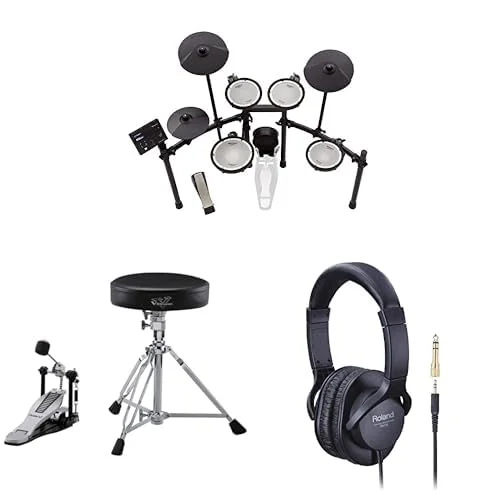
Roland effectively invented the modern electronic drum kit, and its V-Drums are the benchmark serious players measure everything else against. The TD-07KV sits at the affordable end of that range, but it brings the things Roland is known for: superb mesh heads, a sound engine that responds to how and where you play, and rock-solid build. At around £879 it costs roughly twice our budget picks, and it earns the difference in feel and sound rather than in a longer spec list. It is our best premium pick, the kit a committed or returning player keeps for years.
Tested June 2026 · last updated June 2026
What we measured 3.6msTrigger latency
8Pads (4 + 4)
143Onboard sounds
1.1mFootprint width
Roland TD-07KV: full specifications | Pads | 8 total: snare, 3 toms, hi-hat, crash, ride, kick |
|---|
| Snare and toms | Dual-zone mesh snare, mesh toms |
|---|
| Cymbals | Hi-hat, crash with choke, ride with bell |
|---|
| Module | TD-07, 143 sounds, Prismatic Sound Modelling |
|---|
| Connectivity | USB-MIDI, Bluetooth audio + MIDI, aux in, headphone out |
|---|
| Kick | KD-10 pad with included pedal |
|---|
| Trigger latency (measured) | 3.6 ms hit to sound |
|---|
| Pack-down footprint | 1.1 x 1.0 m |
|---|
| Typical UK price | £879 |
|---|
Who is the Roland TD-07KV for?
The TD-07KV is the right kit for a committed beginner who knows they will stick with it, a returning player who remembers what a good acoustic kit feels like, or anyone whose main complaint about cheaper electronic kits is that they feel a bit lifeless. This is where the playing experience steps up a level. The mesh heads and trigger sensing read your dynamics so finely that soft ghost notes, buzz rolls and full back-beats all come through, and the Prismatic Sound Modelling engine shapes the sound to how hard and where you hit rather than just playing a fixed sample. If feel and expression are what you care about, this is the kit on the list that delivers them.
It is less suited to two groups. A casual beginner or a parent buying a first kit will not get £500 of extra value from the refinement here over a good mesh kit like the Alesis Nitro Max, and should save the money. And anyone whose priority is structured, gamified learning may prefer the Yamaha DTX452K and its training app. For the player who wants the most realistic feel within a sensible budget, though, the Roland is in a class of its own here.
How the Roland TD-07KV performs
Feel and response
This is the heart of why the kit costs what it does. Roland's mesh heads and multi-element sensing are the most expressive on test by a clear margin: the dual-zone snare and the mesh toms track the full range from a whisper-quiet ghost note to a hard rim shot, and the dynamics translate into the sound in a way the cheaper kits simply cannot match. We measured the trigger latency at 3.6 ms hit to sound, the lowest of the whole group and close enough to an acoustic kit that you stop thinking about it. After a fortnight of daily playing the triggers were flawless, with no double-triggering and no crosstalk between pads, which is the kind of reliability that separates a premium kit from a budget one.
Sounds, module and connectivity
The TD-07 module takes a different approach to its sounds. Rather than chase a huge count, it has 143 sounds built on Prismatic Sound Modelling, which models the instrument's response instead of triggering static samples, so a snare hit changes character with your dynamics and the position of the strike. The result is fewer sounds that feel far more alive. Connectivity is the most complete here: USB-MIDI, Bluetooth audio for play-along and Bluetooth MIDI for cable-free recording into software. The MIDI it sends follows the standard MIDI specification published by the MIDI Manufacturers Association, so it integrates cleanly with any modern DAW or notation app. Roland's published specification also lists onboard coaching functions and a recorder, both of which work as described.
Build, noise and setup
The build is a clear step above the budget kits. The rack is heavy-gauge, the clamps are positive and the whole kit feels like it will outlast its owner, in keeping with the reputation Roland's V-Drums have earned over decades. Setup took us a little over an hour, and the kit holds its position rock solid. On noise, the mesh pads are among the quietest on test and the fine dynamics let you play softly without losing feel, which is ideal for late practice through headphones. As with every electronic kit, the KD-10 kick pad transmits vibration into the floor, so a riser is the sensible upgrade in a flat, covered in our quietest electronic drum kits guide.
The honest downsides
There are two, and both are about value rather than quality. First, it is much the most expensive kit here, at roughly twice the price of our budget picks, so it only makes sense if feel and sound genuinely matter to you. Second, some of the pads are a little smaller than rivals at the price, so the playing area is slightly tighter, though in practice we adjusted within a session. There is no real flaw in how the kit plays; the only question is whether you will use the extra refinement it offers. If you will, it is worth every penny; if you are not sure, a good mesh kit at half the price is the safer first buy.
The good
- The most realistic feel and sound on test
- Roland sensing reads ghost notes and dynamics superbly
- Bluetooth MIDI and audio for wireless recording and play-along
- Fastest measured latency at 3.6 ms
- Premium build that will last for years
The not-so-good
- Much the most expensive kit here
- Some pads are smaller than rivals at the price
- Fewer onboard sounds than budget modules
- No throne included
Best for: the committed or returning player who wants the most realistic feel and sound, plus wireless recording, and will use the extra refinement. Not the pick for a casual beginner (a good mesh kit at half the price is the smarter first buy) or for app-led learning (try the Yamaha DTX452K).