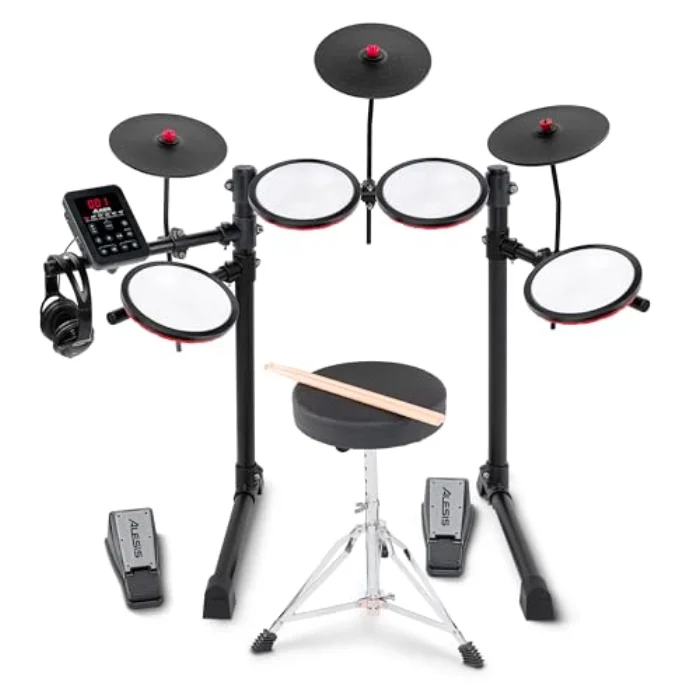
Most kits at this price still use loud rubber pads, which is exactly why the Alesis Turbo Mesh stands out. For around £249 it gives a complete beginner, or a parent buying for a child, a genuine mesh playing surface that is quiet enough for a flat and far more natural to play than the rubber sets it competes with. The module and features are pared back to hit the price, but the playing feel, the thing that decides whether a learner keeps going, is the one place Alesis has not cut. That makes it our best budget pick.
Tested June 2026 · last updated June 2026
What we measured 6.1msTrigger latency
7Pads (4 + 3)
120Onboard sounds
0.95mFootprint width
Alesis Turbo Mesh: full specifications | Pads | 7 total: snare, 3 toms, hi-hat, crash, ride, kick |
|---|
| Snare and toms | All-mesh, single-zone |
|---|
| Cymbals | Hi-hat, crash, ride (no choke) |
|---|
| Module | Turbo, 120 sounds, 10 preset kits |
|---|
| Connectivity | Aux in, headphone out (no USB-MIDI) |
|---|
| Kick | Trigger pad with included single pedal |
|---|
| Trigger latency (measured) | 6.1 ms hit to sound |
|---|
| Pack-down footprint | 0.95 x 0.85 m |
|---|
| Typical UK price | £249 |
|---|
Who is the Alesis Turbo Mesh for?
The Turbo Mesh is the right kit for the absolute beginner, and especially for a child or a careful adult learner on a tight budget. The module is simple, with 120 sounds and ten preset kits, so there is nothing intimidating to learn, and the compact rack tucks into a box room or the corner of a bedroom where a fuller kit will not go. The all-mesh pads are quiet enough to practise through headphones at any hour, which is often the whole reason a family buys an electronic kit in the first place. If your aim is to give drumming a serious try without spending much, this is the kit that lets you do it.
It is less suited to anyone who already knows they are committed. The single-zone pads mean no separate rim sounds, there is no USB-MIDI so it cannot record or trigger software, and the crash has no choke. A developing player will bump into those limits within a year or two, at which point the Alesis Nitro Max or the Donner DED-200 is the natural step up. As a first kit, though, the things it leaves out are things a beginner will not miss for months.
How the Alesis Turbo Mesh performs
Feel and response
The reason to choose this kit over a cheaper rubber set is the mesh, and it does its job. All four drum pads use mesh heads with a gentle, forgiving rebound that is kind to a beginner still building control, and the kit stays quiet in the room as a result. We measured a trigger latency of 6.1 ms hit to sound, a touch slower than the dearer Alesis kits but still well under the roughly 10 ms threshold at which lag becomes noticeable, so it never feels sluggish. The pads are single-zone, so a rim shot triggers the same sound as a centre hit, but for learning the basics that is no handicap at all.
Sounds, module and connectivity
The Turbo module is deliberately simple. According to Alesis's published specification there are 120 sounds and 10 preset kits, a metronome and a small set of built-in play-along tracks, and the screen is a basic LED display rather than a backlit panel. For a first kit that simplicity is a feature, not a fault: there is nothing to get lost in, and a child can change kits and start the metronome unaided. The significant omission is USB-MIDI, the standard USB MIDI device class connection that lets a kit record into software, so the Turbo Mesh cannot connect to a laptop to record or to trigger drum software, and there is no Bluetooth. Play-along has to come through the aux input on a cable. If recording is on your horizon, this is the kit's one real limitation, and the main reason to consider spending a little more.
Build, noise and setup
The compact rack is lighter than the dearer kits but held its position fine over our test, and assembly took about forty minutes with the printed guide. The small footprint is a genuine selling point for a tight room. On noise, the mesh pads keep things quiet through headphones, with only a soft stick thud in the room; the kick pedal, as ever, sends vibration into the floor, so a rug helps in a flat. The bundled kick pedal and the lack of a throne are the usual caveats at this price, and a sturdier pedal is a sensible early upgrade if the kit gets heavy use.
The honest downsides
There are three, all of them deliberate cost savings. First, there is no USB-MIDI, so the kit cannot record or trigger software, which a committed player will eventually want. Second, the pads are single-zone, so there are no separate rim or cross-stick sounds. Third, the crash has no choke and the sound set is small at 120 voices. None of these matters to a complete beginner in their first months, and all of them are exactly what you would expect to give up to reach this price with mesh pads intact. If any of them matters to you now, the step up to the Nitro Max is the answer.
The good
- Cheapest all-mesh kit we trust
- Quiet enough to practise in a flat through headphones
- Compact rack suits box rooms and children
- Simple module is easy for a complete beginner
- Usable 6.1 ms measured trigger response
The not-so-good
- No USB-MIDI, so no recording or software
- Single-zone pads (no separate rim sounds)
- No crash choke and only 120 sounds
- Basic LED screen and bundled pedal
Best for: the complete beginner or child who wants a quiet, natural mesh kit at the lowest sensible price and does not yet need to record. Not the pick if you want USB-MIDI recording or rim sounds (step up to the Alesis Nitro Max or Donner DED-200).